
How to Write a CV Summary (Personal Statement) That Actually Sells You
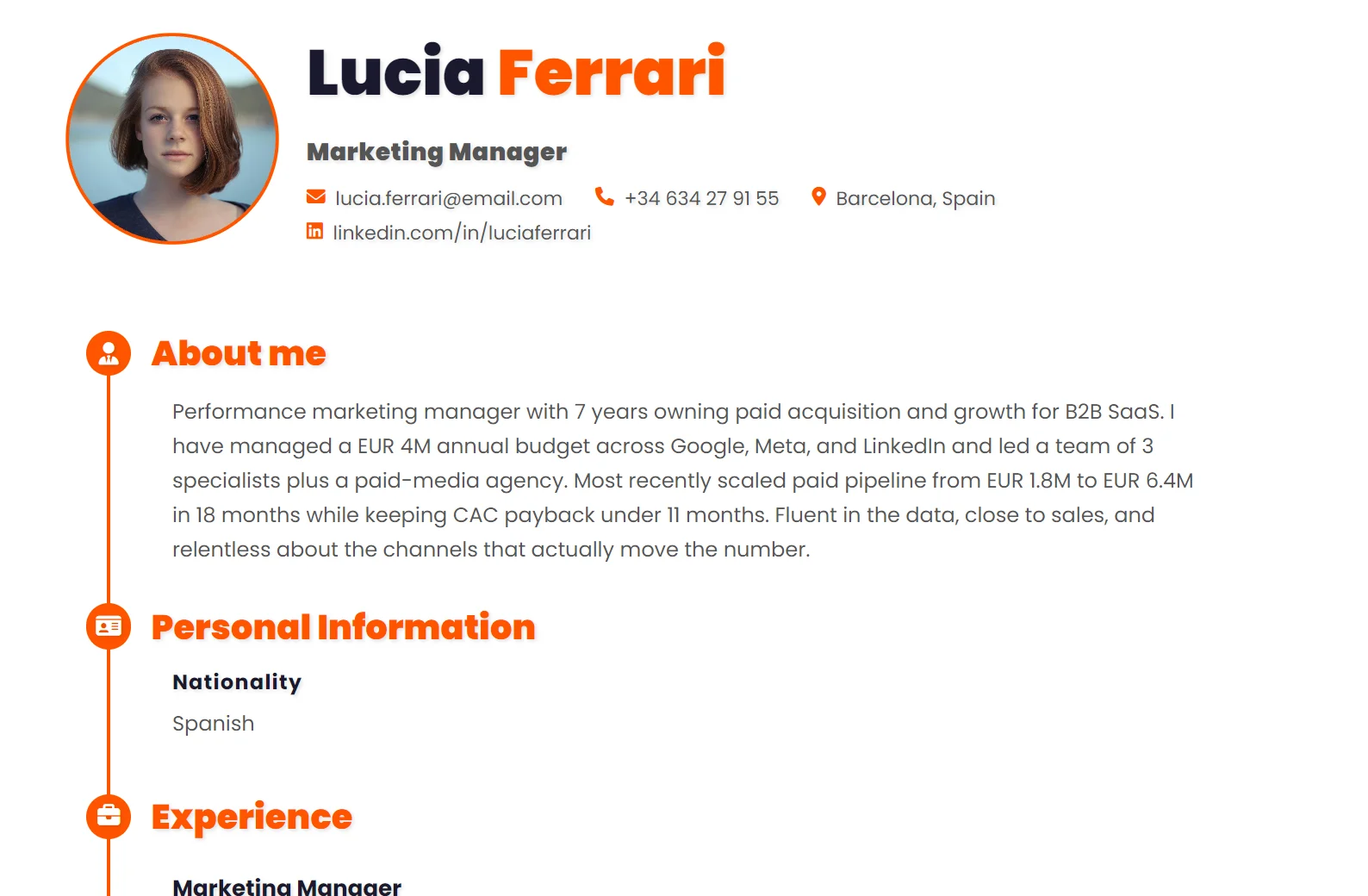
The CV summary — also called a professional summary, personal statement or profile — is three sentences, each with one job: who you are professionally, what you are strongest at, and what you want next. Keep it to 50-80 words, sit it directly under your name and contact details, and write it last, once the rest of the CV exists to distil. It's the first thing the recruiter reads and almost always the only thing they'll fully read before deciding whether to keep going. Done well, a summary earns you the rest of the document's attention. Done badly, it gets your CV closed within ten seconds. This guide gives you the structure that works, five worked examples covering different career stages, and the specific words to retire so yours doesn't read like everyone else's.
Summary vs. objective — and why the difference matters
Before anything else, get clear on which one you're writing. The CV summary and the career objective sit in the same spot on the page but do completely opposite jobs:
- An objective tells the recruiter what YOU want — "seeking a challenging position where I can grow my skills and contribute to a dynamic team"
- A summary tells the recruiter what you OFFER — "backend engineer who has scaled three production systems past 10M requests per day"
- One is about you; the other is about them. Recruiters read CVs to find people who solve their problems, not to grant career wishes. Write the one about them
Career objectives were standard 20 years ago and have been quietly fading out ever since. Today, leading with one signals you're either junior, out of practice with modern conventions, or unsure what you bring. The only place an objective still works is in a CV for your very first job — when you genuinely have nothing yet to summarise. In every other case, replace it with a summary.
CV buzzwords to cut — and what to write insteadThe three-sentence structure that works
There's a universal structure for the summary that works across industries, seniority levels, and career situations. Three sentences, each with a specific job:
Sentence 1: Who you are, professionally
Your title and years of experience, plus the field you operate in. This is the 1-second answer to "what is this person?". Concrete beats clever; clarity beats flavour.
- Weak: "Versatile professional with extensive experience in multiple domains."
- Strong: "Senior backend engineer with 8 years building payments infrastructure at fintech startups."
Sentence 2: What you're known for (or specialise in)
The angle that distinguishes you from other people with the same title. Ideally with a concrete proof point — a system you scaled, a deal size you closed, a team you grew, a metric you moved.
- Weak: "Strong skills in technical leadership and cross-functional collaboration."
- Strong: "Strongest in 0-to-1 work: led the initial build of three systems that now handle a combined 4B requests per month."
Sentence 3: Forward-looking — what you want next
What kind of role you're now looking for, framed in a way that connects your past to the role you're applying to. This is also where career changers explicitly name the change and what makes the past relevant.
- Weak: "Seeking new opportunities to grow."
- Strong: "Looking for a staff-level role where I can shape payments architecture for a growing engineering team."
Three sentences. Concrete. Forward-looking. Together they tell the recruiter exactly what to do with this CV in under 10 seconds.
Use the right action verbs to make those concrete sentences hit harderWorked examples by career stage
The structure stays the same; the content adapts to where you are. Here are five summaries written for very different situations:
Mid-level professional
"Product designer with 6 years of experience in B2B SaaS. Strongest in early-stage 0-to-1 work, having led the initial design of three products that hit $1M+ ARR. Looking for a senior role where I can shape product strategy alongside design."
Why it works: concrete years, concrete domain, a specific kind of work she's known for, a real outcome, and a clear ask. A recruiter can move forward in 8 seconds.
Career changer
"Former secondary-school maths teacher (8 years) transitioning into data analytics. Recently completed the Google Data Analytics certification and built three end-to-end SQL/Tableau projects on Kaggle. Looking for an entry-level data analyst role where my experience explaining complex ideas clearly is an asset, not a footnote."
Why it works: names the transition openly, shows concrete steps already taken (cert + projects), and reframes the past as a strength rather than apologising for it. Career changes that try to hide the change always read as evasive.
Senior leader
"VP of Engineering with 15 years building and scaling product organisations from 5 to 80+ engineers. Took two startups through the messy middle (Series B to D), shipping platform rewrites without slowing feature velocity. Looking for a CTO role at a growth-stage company where engineering culture is still being built."
Why it works: senior summaries lead with scope (org size, deal size, geographies) more than skills. The reader needs to know whether the candidate operates at the right altitude before anything else matters.
Recent graduate
"Computer-science graduate from TU Delft (2026) with a thesis on distributed consensus algorithms. Three internships across backend and infrastructure (Booking.com, Adyen, a 5-person seed-stage startup), plus a maintained open-source Rust CLI with 1,200+ stars. Looking for a backend engineering role where I can keep working on systems problems."
Why it works: graduates often have less to lean on, so concrete proof matters more — the school, the thesis topic, the specific companies, the GitHub artefact. Skip "recent graduate eager to learn"; that signals you have nothing else to say.
Returning after a career gap
"Senior marketing manager with 10 years in consumer brand work, returning to full-time roles after a 2-year career break for family. Most recently led the rebrand of a €50M skincare line that lifted brand recall by 22% in the EU. Looking for a senior brand role where deep consumer empathy and a fresh perspective add up to more than continuous time-served."
Why it works: addresses the gap openly in one sub-clause and moves on. The middle sentence is what would have led the summary if the gap didn't exist; the third reframes the gap as net-positive. Hiding gaps doesn't work — they show up in the dates section anyway.
Buzzwords to retire — and what to write instead
Certain phrases appear in so many CV summaries that recruiters' eyes literally skip them. They're not memorable; they're invisible. The fix is always the same: replace the abstract claim with a concrete fact.
- "Passionate self-starter" → name the thing you're passionate about. "Maintainer of a 12k-star open-source CLI" conveys passion. "Passionate developer" does not
- "Results-driven" → the result itself. If you really got results, the sentence that names them is the proof; the adjective is filler
- "Strong attention to detail" → the kind of work where that mattered. "Wrote and audited the SOX compliance documentation for two annual external reviews" beats "strong attention to detail" by a mile
- "Team player" → the team. "Embedded across three product squads as the cross-team SRE" beats "team player" because it shows it
- "Strategic thinker" → a strategic decision you actually made. "Pivoted the roadmap from B2C to enterprise in 2024 after the freemium funnel stalled" — that's strategic thinking, demonstrated
- "Excellent communication skills" → who you communicated with and what you produced. "Authored quarterly board updates for a $200M-revenue division" lands; "excellent communicator" doesn't
The rule of thumb: if a recruiter could copy your phrase and paste it into 50 other CVs without anyone noticing, it doesn't belong in yours. Adjectives describe; specifics prove.
Other tired CV phrases on the wider list of common mistakesTailor the summary to each application
The summary is the single highest-leverage paragraph for tailoring. Three minutes of editing here moves your CV from the rejection pile to the read pile more often than three hours editing anywhere else.
Two things to do for every application:
- Mirror the exact vocabulary of the job description. If they say "customer success," don't write "client relations." If they say "distributed systems," don't write "large-scale software." ATS matching is literal; synonyms don't count
- Lead with the angle the job emphasises. If the role focuses on growth, the middle sentence is about growth work. If it focuses on technical depth, the middle sentence is about systems built. Same career, different framing per application
If you have a master CV (and you should), keep three or four pre-written summary variants tuned for different role flavours — generalist, specialist, leadership, technical depth. Then for each new application, pick the closest one and edit two or three words to match the specific posting. Three minutes total.
How to tailor the rest of the CV in 15 minutes per applicationLength, placement, and tone
Once the structure and content are right, three smaller decisions remain:
- Length: 50-80 words for the typical CV. Less than 30 feels thin and underdone; more than 100 reads as an essay and stops being a summary. If you can't say what you mean in 80 words, you don't yet know what you mean
- Placement: directly under your name and contact details, above the experience section. No heading is needed ("Summary" or "Professional Profile" is fine but optional)
- Tone: third-person implied — "Senior backend engineer with 8 years…" rather than "I am a senior backend engineer with 8 years…". Skipping the "I" reads as more confident and saves precious words. Don't refer to yourself in the third person by name; the implied first-person without pronouns is the standard
Once you've made these three choices, lock them in for every variant of your CV. Consistency across applications matters more than getting any one detail philosophically perfect.
How summary keyword-matching factors into ATS scoringWrite your summary LAST, not first
Almost everyone writes the summary first because it's at the top of the page. That's the wrong order. The summary distils everything else in the CV — but you can't distil what doesn't yet exist.
Better sequence:
- Write your experience bullets first, with verbs and metrics
- Write the skills section second, grouped and tailored
- Read your own CV as if it were someone else's. Identify the three strongest things in it
- Condense those three things into the three sentences of the summary
The result is a summary that's actually a summary — built from the rest of the document, not detached from it. The added benefit: it'll be honest. Summaries written first tend to be aspirational (what you wish you had done); summaries written last tend to be accurate (what you actually did). Recruiters can tell the difference; you don't need to be the one explaining it in the interview.
How to write the experience section your summary will draw fromPre-send checklist
- 50-80 words, three sentences
- Sentence 1: role + years + field
- Sentence 2: what you're known for, with a concrete proof point
- Sentence 3: what you're looking for next, connecting past to target role
- No "objective" framing (no "I am seeking…")
- No buzzwords that 50 other applicants could also write
- Vocabulary mirrors the job posting where it makes sense
- First-person implied (no "I"); no third-person-by-name
- Written AFTER the experience and skills sections, not before
Run this checklist for 60 seconds before submitting. A summary that passes all nine items lands every CV ahead of the 90% of summaries that read as generic. That's the entire job — be the one a recruiter remembers reading.
Write yours in the builder and watch it land on the page as you typeFrequently asked questions
What should a CV summary say?
Three things in three or four lines: what you are, at what level and in what field; the single strongest piece of evidence you can offer; and what you are looking for now. Written in the third person by implication — no "I", no adjectives you cannot prove.
How long should a CV personal statement be?
Three to four lines, or roughly 40 to 60 words. Long enough to place you and give one proof point, short enough that a recruiter reads it rather than skipping to the first job. Anything approaching a paragraph gets skimmed past entirely.
Does a CV need a summary at all?
It helps most when your next step is not obvious from your last job — career changers, returners, and anyone whose title does not describe what they actually do. If your history speaks for itself and space is tight, the room is better spent on achievements.
What should you never put in a CV summary?
Unprovable adjectives — "hard-working", "passionate", "detail-oriented", "team player". Every candidate writes them and none of them survive a follow-up question. Replace each with the fact that made you want to claim it in the first place.