
200+ Strong Action Verbs for Your CV (Organised by Skill)
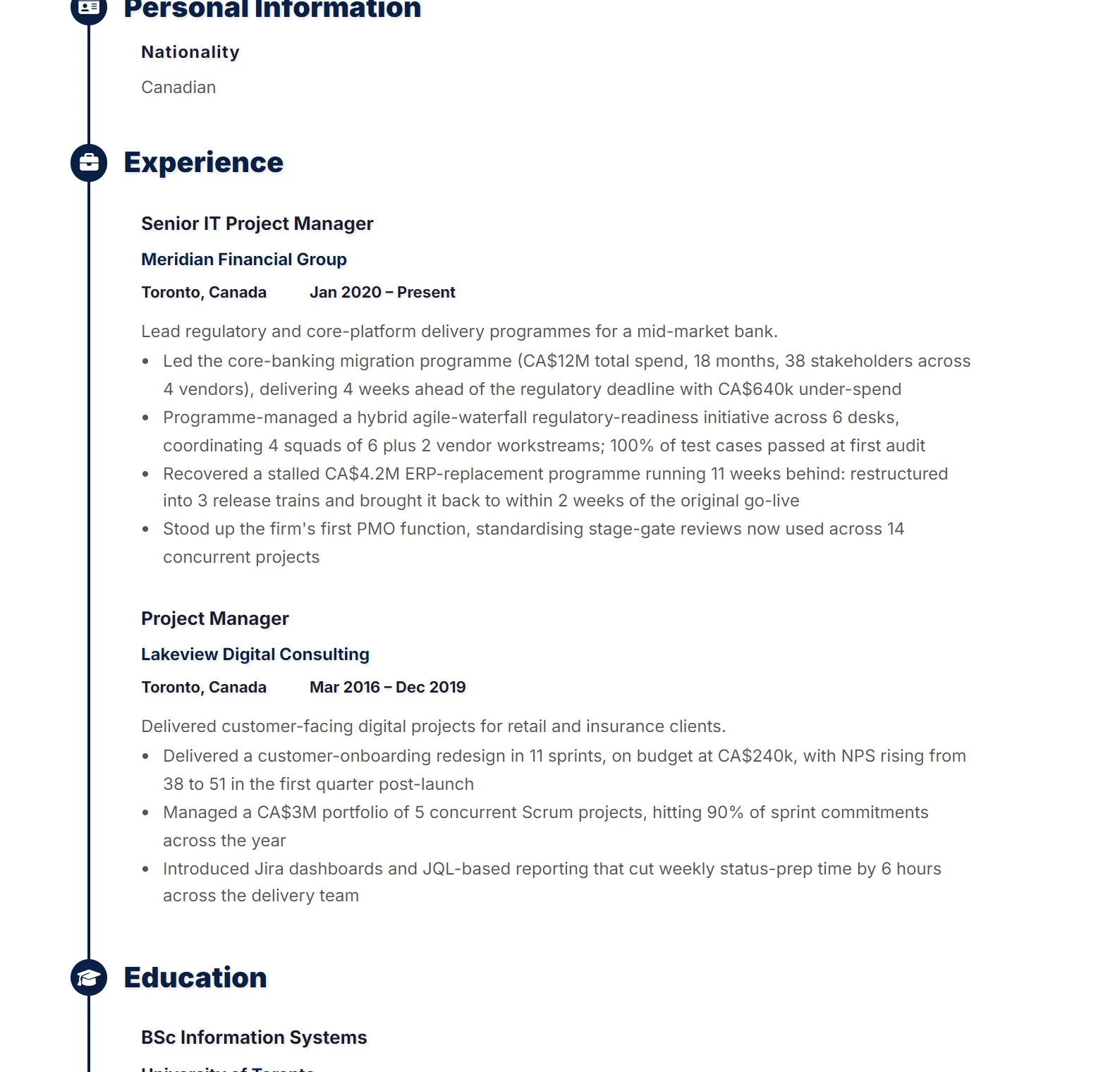
Open every bullet with a verb and close it with a number: 'cut onboarding from 14 days to 4', not 'responsible for onboarding'. That pairing is the whole technique; the verbs below are grouped by what each one signals, so you can match the verb to the achievement instead of reaching for the same three. Most CVs are written in the dead language of "responsible for". "Responsible for managing the team." "Responsible for the rebranding project." "Responsible for budgets." None of those sentences tell a reader what you actually did — they describe a job title's job description. Action verbs replace that flatness with motion: led, rebuilt, cut, shipped, doubled, recovered. Same facts, dramatically different impression. This guide is a working library of the verbs that move CV bullets from passive to memorable, grouped by what they signal and paired with rewrites you can model your own bullets on.
Why action verbs change how recruiters read your CV
Recruiters read a CV the way most of us read a book on a beach — they're not poring over every word; they're scanning for shapes. A bullet that opens with a strong verb registers as "this person did something." A bullet that opens with "responsible for" or "worked on" registers as "this person was present." The difference takes the eye about 200 milliseconds to compute and shapes the rest of the read.
There's a second effect that matters as much: action verbs force you to make a claim. "Responsible for the migration" leaves the outcome unspoken; "migrated 18 services to Kubernetes with zero downtime" can't avoid telling the reader what actually happened. The verb you choose constrains the rest of the sentence — and that constraint is what makes the bullet land.
- Strong opening verb = the eye registers the bullet as an achievement, not a duty
- Verb choice forces a specific claim — vague verbs let the bullet stay vague
- Variety matters: ten bullets all starting with "led" reads as a thesaurus failure
- ATS systems don't penalise repeated verbs, but human readers tune them out
The verb categories that cover 90% of achievements
Almost any professional achievement falls into one of five buckets. Knowing which bucket your achievement belongs to makes verb selection a 10-second decision instead of a 10-minute thesaurus crawl.
1. Leadership & ownership
For times you ran a team, drove a decision, owned a result, or coordinated a group. These verbs imply authority and visible accountability.
- Led, headed, directed, spearheaded, drove, oversaw, coordinated, orchestrated, mobilised, chaired
- Mentored, coached, developed, supervised, guided, championed, advocated, sponsored
- Owned, governed, stewarded, prioritised, arbitrated, negotiated, brokered, aligned
2. Building & creating
For times you built something new — a product, a process, a team, a document, a relationship. Avoid "created" when you can — almost any verb in this list lands harder.
- Built, designed, architected, engineered, prototyped, drafted, modelled, formulated
- Launched, shipped, deployed, rolled out, introduced, established, founded, instituted
- Authored, composed, produced, devised, conceived, pioneered, originated
3. Improving & optimising
For times you took something that already existed and made it measurably better. This is the category where metrics matter most — pair the verb with a number and the bullet writes itself.
- Improved, enhanced, refined, upgraded, modernised, streamlined, simplified
- Accelerated, doubled, tripled, scaled, expanded, grew, multiplied
- Reduced, cut, lowered, slashed, trimmed, eliminated, consolidated, automated
4. Analysing & researching
For times you investigated, evaluated, modelled, or made sense of something. Strongest in research, finance, strategy, and data roles.
- Analysed, evaluated, assessed, audited, investigated, examined, scrutinised
- Researched, surveyed, mapped, benchmarked, quantified, forecasted, projected
- Identified, uncovered, diagnosed, validated, verified, synthesised, distilled
5. Resolving & troubleshooting
For times you fixed a broken thing, navigated a crisis, or unblocked progress. Especially strong for support, operations, and engineering roles.
- Resolved, fixed, repaired, remediated, salvaged, recovered, restored
- Debugged, troubleshooted, isolated, traced, root-caused, untangled
- Negotiated, defused, mediated, reconciled, settled, contained, mitigated
Before-and-after: weak phrasing rewritten
Verb choice is hard to feel in the abstract. Here are six common CV bullets rewritten with stronger verbs and tighter claims — the kind of edit that takes 30 seconds per bullet and lifts an entire page:
- Before: Responsible for managing a team of 8 engineers. → After: Led an 8-person engineering team through the migration of the billing system from monolith to services.
- Before: Worked on improving the onboarding flow. → After: Redesigned the onboarding flow, lifting 7-day activation from 38% to 61% in one quarter.
- Before: Helped with quarterly reporting. → After: Automated quarterly reporting in Looker, cutting analyst prep time from 14 hours to 90 minutes.
- Before: Was part of the launch team for the new app. → After: Shipped the launch version of the iOS app, owning the auth flow and the in-app purchase pipeline.
- Before: Dealt with customer complaints. → After: Resolved 200+ escalated cases per month with a 94% CSAT and a 3-hour median response time.
- Before: In charge of social media. → After: Grew the Instagram following from 4k to 38k in 11 months through a weekly creator-collaboration series.
How to pair verbs with metrics — the formula
A strong verb without a metric is half a bullet. A metric without a strong verb is the other half. Combine them and you get the structure that consistently wins reader attention:
Formula: [Strong verb] + [what you did, specifically] + [measurable result, with a number or comparison]
- Numbers don't have to be revenue — counts, percentages, hours saved, latency improvements, and customer-satisfaction scores all count
- If you don't have a hard number, use a comparison: "reduced rebuilds from twice a week to once a month"
- If the absolute number is small but the relative gain is large (or vice versa), use the more impressive one — "cut from 8% to 2%" reads as "4× improvement"
- If you genuinely have no metric, anchor on scope: team size, transaction count, geographies, customer segments, deal value, codebase size
Verbs and phrases to retire
Some words and phrases have appeared on so many CVs that they've stopped meaning anything. They take up bullet real estate without telling the reader anything new. Replace each of these with a verb from the categories above:
- "Responsible for" — describes a job description, not a contribution. Replace with the verb that names what you actually did
- "Worked on" — could mean led, contributed, observed, or rubber-stamped. Pick the verb that's actually true
- "Helped with" — admits you weren't the owner. If you were, use a stronger verb. If you weren't, name the contribution specifically ("reviewed the analysis", "drafted the rollout plan")
- "Involved in" — same problem as "worked on" but more passive
- "Assisted with" — fine for entry-level CVs where you genuinely were a junior contributor; weak everywhere else
- "Tasked with" — describes the assignment, not the outcome
- "Duties included" — the most boring possible opener; always replaceable
Quick-reference action verb library
When you're stuck, scan this list and pick the verb that most accurately describes what you did. Specificity beats variety: "orchestrated" and "led" both signal leadership, but "orchestrated" implies coordination across moving parts — only reach for it if that's what actually happened.
Verbs that quantify growth
- Grew, scaled, doubled, tripled, multiplied, accelerated, expanded, lifted, boosted, advanced, amplified, surged
Verbs that quantify reduction
- Cut, reduced, slashed, lowered, trimmed, eliminated, consolidated, condensed, halved, decreased, contained, capped
Verbs that signal technical execution
- Built, engineered, designed, architected, prototyped, deployed, shipped, released, integrated, migrated, refactored, optimised, instrumented, automated
Verbs that signal influence without authority
- Convinced, persuaded, advocated, championed, aligned, secured, negotiated, brokered, partnered, mobilised, rallied, galvanised
Verbs that signal teaching and people development
- Mentored, coached, trained, taught, onboarded, upskilled, developed, guided, supervised, evaluated, promoted
Pre-send checklist
- Every experience bullet starts with a strong verb in the past tense (or present tense for your current role)
- No bullet starts with "Responsible for", "Worked on", "Helped with", or "Involved in"
- Verbs vary across consecutive bullets — same verb twice in a row reads as lazy editing
- Each verb is paired with a measurable result or a concrete scope marker
- The verb actually matches what you did — don't "orchestrate" what you just contributed to
- Top three bullets per role use the strongest verbs you have for that role
- Tense is consistent within each role (don't mix past and present in the same job)
Verb choice is the easiest CV upgrade with the highest ROI. It costs you 20 minutes of editing for an entire CV and changes how every bullet lands with both ATS and human readers. The library above gives you 200+ options grouped by what they signal — combine that with the formula "[verb] + [what] + [measurable result]" and your CV stops reading as a list of duties and starts reading as a list of things you actually did.
How ATS systems handle your verbs — keyword matching and parsingFrequently asked questions
Why should CV bullets start with an action verb?
Because the first word decides whether a line reads as something you did or something you were assigned. "Responsible for the migration" describes a job description; "Migrated 40 services" describes a person. It also saves words, and on a two-page CV every recovered word buys evidence.
What are the strongest action verbs for a CV?
Ones that name a specific action with a visible result: built, launched, negotiated, reduced, automated, rewrote, recovered, consolidated. Weak ones are vague or passive: assisted, helped, participated, was involved in, supported. If a verb could describe watching the work happen, replace it.
Should you repeat the same verb across a CV?
Avoid using the same one three times on a page — it flattens the writing and makes the roles blur together. But do not reach for a thesaurus either: an odd, over-formal verb is worse than a plain one used twice. Vary where it is natural, not everywhere.
What words should you never start a CV bullet with?
"Responsible for", "Duties included", "Tasked with", "Helped with" and "Worked on". All five announce that what follows is a job description rather than an achievement. Each can be rewritten by asking what actually changed and starting the line with that verb instead.