
The Best Skills to Put on Your CV in 2026 (and How to Pick Yours)
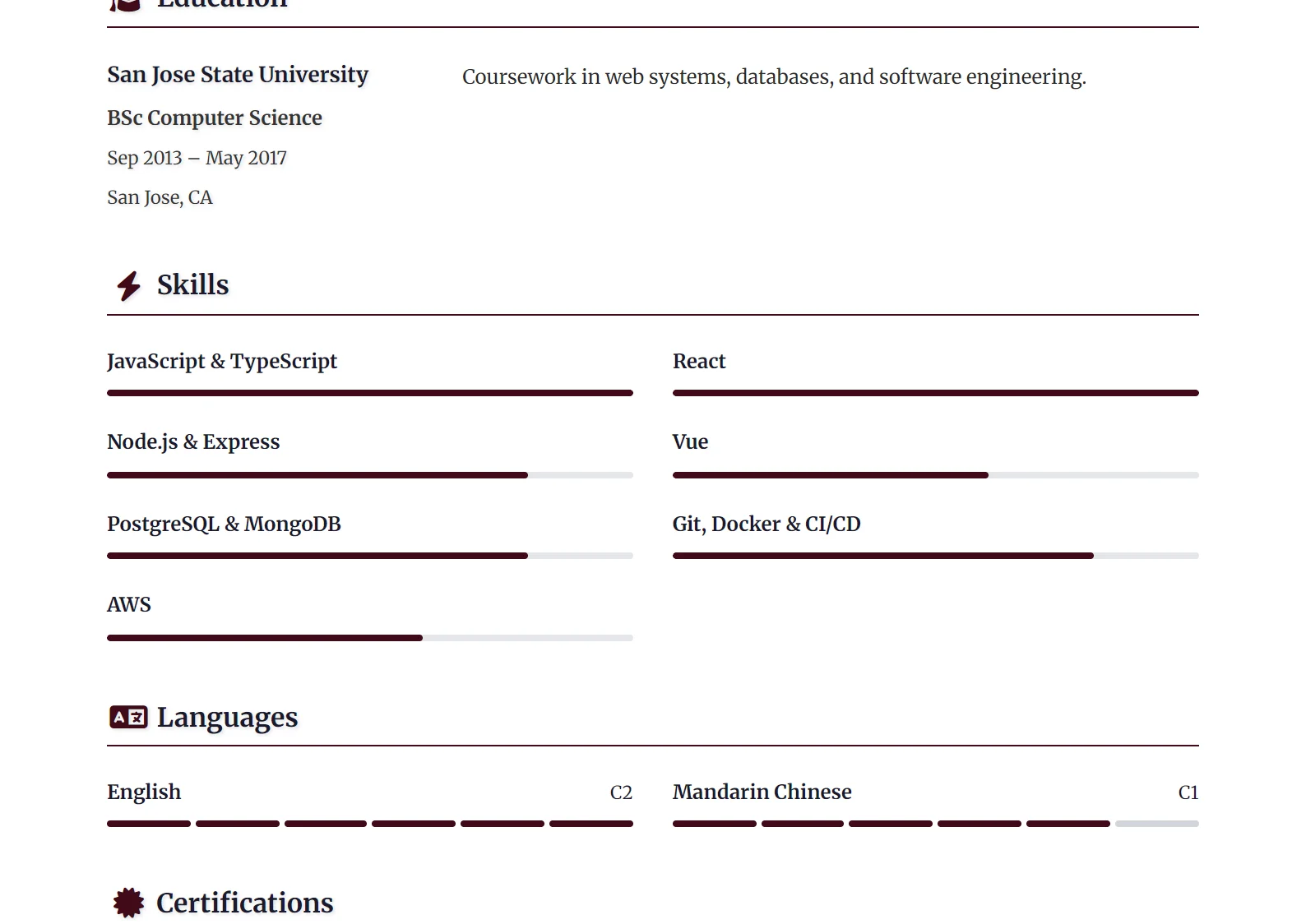
List 8 to 12 skills, not 30. Take them from the job description, make sure each one is proved somewhere else on the page, group them into three or four labelled clusters, and put the section after your summary and above your experience. A skills section is the easiest thing on a CV to write badly. Most people either dump every tool they've ever touched into a long bullet list, or pick five vague soft skills ("team player, communication, leadership") that say nothing. A good skills section does two jobs at once: it gives an ATS the keywords it's scanning for, and it gives a human reader a 5-second summary of what you can actually do.
Hard skills vs. soft skills — and why both belong on your CV
Hard skills are teachable, testable abilities: Python, SQL, financial modelling, German at B2 level, MIG welding. They're easy to verify and easy for an ATS to match against a job description. Soft skills are interpersonal and behavioural: negotiation, mentoring, stakeholder management, conflict resolution. They're harder to verify but matter just as much in most senior roles.
The trap is treating them as equivalent in the skills section. A line like "Python, SQL, communication, teamwork" reads strangely because the first two are objectively measurable and the last two are not. Keep hard skills in the dedicated skills section. Move soft skills into your experience bullets, where you can prove them with a specific moment.
- Hard skills go in the skills section — they're keywords that ATS systems scan for
- Soft skills go in your experience bullets — they're claims that need a concrete story
- If you can't prove a soft skill with a specific situation, don't claim it
- Languages count as hard skills; always include a level (A1–C2, native, conversational)
Where the skills section actually goes
On a one-page CV, the skills section sits in one of two places: a vertical sidebar on the left (most modern templates) or a horizontal block right after the summary. The sidebar version works best for technical roles where the list is long and scannable matters. The horizontal block works better for senior non-technical roles where you want experience to dominate the page.
Either way, the skills section comes before work experience in placement priority but after your summary — a recruiter should know your name, your headline role, and your top skills within five seconds of opening the file.
Skills move to the top when experience is thinHow to choose which skills to list
More is not better. A list of 30 skills signals you don't know what's important; a curated list of 8–12 signals you do. The selection process below picks the right ones.
1. Start from the job description
Paste the job description into a blank document. Highlight every concrete skill word — tools, languages, methodologies, certifications. That's your starting list. If a skill appears twice in the description it's high-priority; if it appears in the title or first paragraph it's mandatory.
2. Prove every skill somewhere else on the page
Every skill in your section should appear at least once in your experience bullets, projects, or education. "AWS" in skills with no AWS work anywhere else looks like padding. Either earn it with a bullet point, or take it off.
3. Group instead of dumping
A flat list of 15 skills is hard to scan. Grouped into 3–4 labelled clusters, the same skills take half the visual space and read in seconds.
Languages: Python, TypeScript, Go
Cloud & infra: AWS, Terraform, Docker, Kubernetes
Data: PostgreSQL, BigQuery, dbt
Tools: Git, Linear, Figma
The "skill bar" mistake (and what works instead)
Many CV builders ship with 5-star skill ratings or progress bars next to each skill. Avoid them. ATS systems strip the visual — your "4/5 SQL" lands as just "SQL" in the parsed text. Worse, a 3/5 next to your top skill tells the reader you're not great at the thing you're applying to do. And a 5/5 next to everything reads as self-promotional rather than honest.
If you want to convey skill level, do it in plain text where it can't be misread:
- For languages, use a recognised standard: "Spanish — C1", "French — B2", "German — native"
- For technical skills, let years of use and project complexity in your experience bullets do the work
- For certifications, list the certification name and year — "AWS Solutions Architect Associate (2025)" beats any star rating
Industry-specific examples that work
What a strong skills section looks like depends heavily on the field. A few templates by industry:
Software & data
Group by category, lead with the languages and frameworks the job lists first, end with tooling. Aim for 12–18 skills total across 3–4 groups. Skip anything you couldn't do under interview pressure.
Marketing & creative
Split into "channels" (paid social, SEO, email, content) and "tools" (HubSpot, Google Analytics, Figma, Adobe CC). 8–12 skills total. List specific platform expertise rather than generic "digital marketing".
Healthcare
Certifications and licences first (BLS, ACLS, specialty board), then clinical procedures, then EHR systems (Epic, Cerner). For clinical roles the skills section often runs longer (15–20) because each one is a verifiable competence.
Finance & operations
Split into "technical" (Excel modelling, SQL, Power BI, SAP), "frameworks" (IFRS, US GAAP, Lean, Six Sigma), and "languages" if relevant. Quantitative roles benefit from naming specific models — "DCF, LBO, sensitivity analysis" beats "financial modelling".
Five mistakes that drag down a skills section
| Mistake | What it costs you |
|---|---|
| Listing skills you can't demonstrate | every line should map to something else on the page |
| Mixing hard and soft skills in the same list | they read as not-comparable and weaken both |
| Using star ratings or progress bars | ATS strips them and humans read them as self-graded |
| Listing tools by category name ("Microsoft Office") instead of the relevant specific ("Excel | Power Query, pivot tables, VBA") |
| Forgetting language proficiency levels | "English" alone tells the reader nothing useful |
Pre-send checklist
- 8–12 skills total, grouped into 3–4 labelled clusters
- Every listed skill appears at least once in experience bullets, projects, or education
- Languages have a recognised level (A1–C2 or native)
- No star ratings, no progress bars, no percentages
- Top three skills mirror the keywords in the job description's title or first paragraph
- Tools listed by specific name, not category umbrella
A skills section that does all of this gives an ATS the matches it needs and gives a recruiter a five-second answer to "what can this person actually do". That's the whole job — anything beyond it is decoration.
Pair this with the right action verbs in your experience bullets