
How to Quantify Your Achievements on a CV (Even If You Don't Track Metrics)
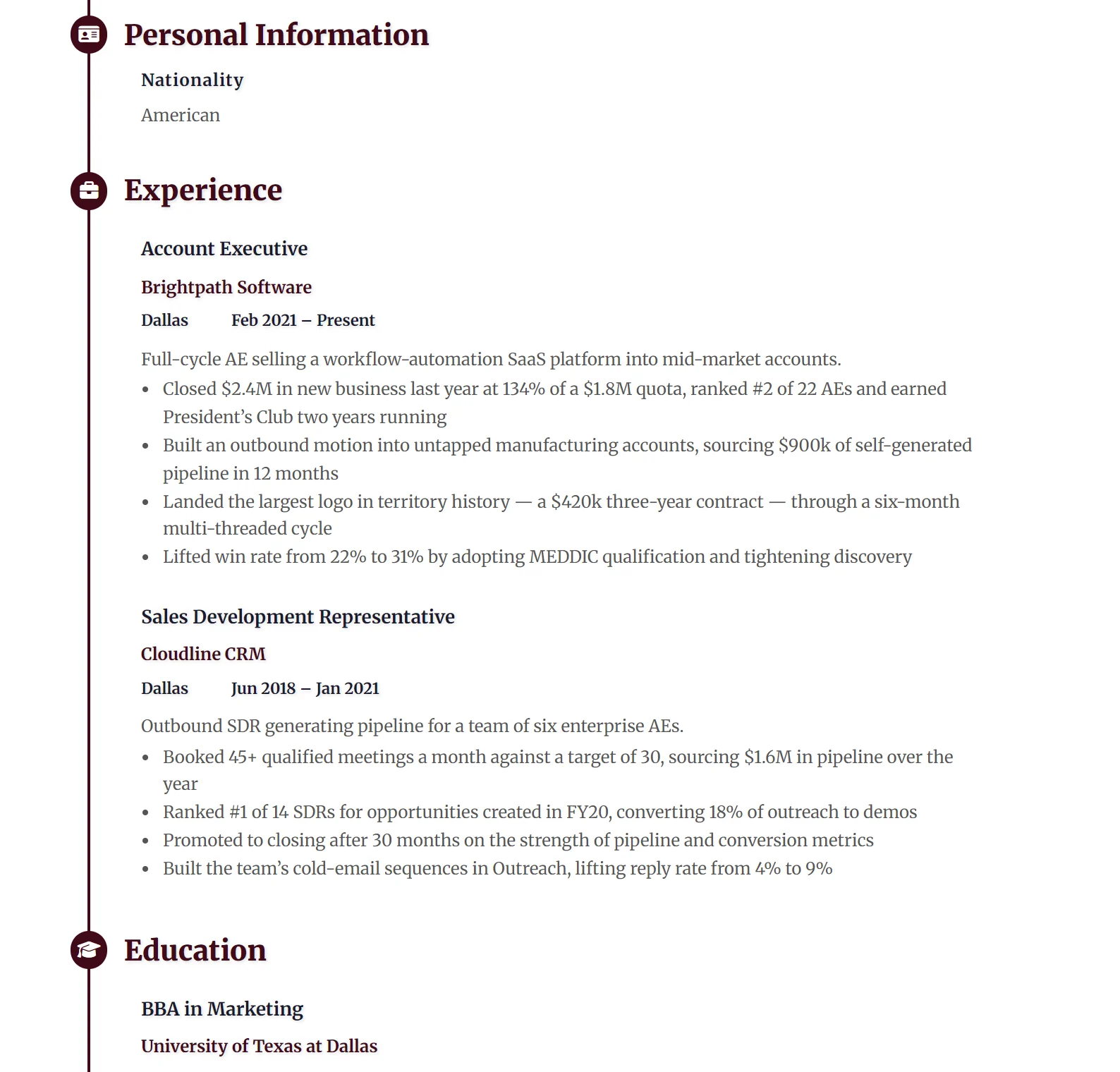
Recruiters scan CVs for numbers. A bullet like "led the customer onboarding redesign" tells them what you did; "led the customer onboarding redesign that cut activation time from 14 days to 4 and lifted week-1 retention by 22%" tells them what the work was worth. Numbers anchor the eye, give scale, and force specificity. But many people work in roles where nobody tracked the metric, the team didn't share dashboards, or the contribution wasn't isolated. This guide shows where to find numbers anyway — including the seven metric categories every role has, the verb-metric-context formula, and how to estimate honestly without fabricating.
Why numbers carry more weight than adjectives
Recruiters spend 6-8 seconds on the first CV pass. In that window the eye lock-on pattern is well documented: it jumps to names, job titles, and numbers. Adjectives are skipped; verbs are skimmed; numbers are read. A bullet with one number gets disproportionately more attention than the three bullets above and below it combined.
There are two reasons numbers work so well:
- They provide scale. "Improved conversion" could mean 1% or 50% — the recruiter has to guess. "Improved conversion 18%" answers the scale question directly
- They force specificity. To write a number, you had to have measured it (or estimated it honestly), which proves you think in outcomes rather than activities
- They survive comparison. Two candidates both say "led the rebrand"; the one whose rebrand "lifted brand recall 22%" wins by default because the other gave the reader nothing to weigh
- They beat the keyword-skim. Even when an ATS forwards CVs based on keyword density, the human who opens the forwarded CVs reads the ones whose bullets contain numbers first
The whole game is to give the recruiter something concrete to remember 30 seconds after closing the file. Numbers do that better than any other CV element.
Pair the numbers with strong action verbs for maximum impactWhat to do when you "don't have metrics"
The honest excuse — "I can't quantify because I don't have the numbers" — is real for most people. But it's almost always solvable. The trick is knowing where to look. Three sources cover 90% of cases:
1. Mine for countable artefacts
Even non-metric roles produce countable things. Walk through your last role mentally and list every countable noun you touched:
- Number of clients managed ("portfolio of 22 SME accounts")
- Number of reports written ("authored 40+ monthly compliance reports across 3 jurisdictions")
- Team size ("managed a team of 6 nurses across two wards")
- Budget or vendor spend ("oversaw €1.2M in annual vendor contracts")
- Audience size ("delivered weekly all-hands updates to an audience of 240+")
- Training sessions delivered ("trained 80+ new joiners across 12 onboarding cohorts")
2. Use proxies and disclosed estimates
When direct metrics aren't available, proxies work. If you don't know exactly how much revenue your project generated, you might know what the line's annual revenue was — that gives you a denominator. If you don't know the conversion lift, you might know the rough before/after of the metric the team was tracking.
Estimates with disclaimers ("~30%", "approximately", "roughly") are more credible than no numbers at all — as long as you can defend the estimate in an interview. "I don't remember the exact figure but the team's quarterly briefings put it around 30%" is a perfectly acceptable interview answer. Fabricating a precise number you can't defend is the actual mistake.
3. Operational wins need no dashboard
Time savings, error reduction, meeting elimination, and process improvements are quantifiable from memory alone. "Cut weekly reporting time from 6 hours to 90 minutes" doesn't need a revenue dashboard — it just needs you to remember how long the work used to take.
Examples that work for almost any role:
- "Eliminated three weekly meetings by introducing async written updates"
- "Reduced average ticket-resolution time from 48 hours to 9 hours"
- "Cut the month-end close from 12 working days to 5"
- "Automated the weekly inventory report (previously 4 hours of manual Excel work)"
The seven metric categories every role has
If you're stuck, scan these seven categories — almost every professional role produces measurable output in at least three of them. Pick the categories that map to your work and dig there.
- Revenue / cost — generated, saved, influenced, protected. The most universal metric; even support roles can claim "prevented churn worth ~€X annually"
- Time — saved, reduced, accelerated. Works for any operational role. Easy to remember without a dashboard
- Volume — processed, handled, managed, shipped. Number of tickets, transactions, deliveries, documents, releases
- Quality — defects reduced, NPS improved, accuracy increased, error rate cut. Useful even when revenue is invisible
- Scope — team size, budget owned, geographies covered, user base served. Senior roles lean on this category most
- Frequency — weekly cadence, daily transactions, monthly outputs. Turns repetitive work into a number
- Satisfaction — CSAT, NPS, retention rate, repeat business. The currency of customer-facing roles
Most roles produce numbers in 3-4 of these categories. If you sit down and list everything you did last year against each category in turn, you'll usually find 8-12 candidate metrics — more than you need for a single CV.
The sector where every line is expected to carry a numberThe Verb + Metric + Context formula
Bullets work hardest when they combine three elements: a strong verb (what you did), a metric (the scale), and context (why the number matters). Any one of these alone is weaker than the combination.
- Verb alone: "Improved checkout conversion." — empty. By how much? On what scale?
- Verb + metric: "Improved checkout conversion 18%." — better, but on what baseline?
- Verb + metric + context: "Improved checkout conversion 18% by simplifying the address form during a $40M holiday season." — lands. The reader knows what you did, by how much, and why it mattered
The formula scales from junior bullets to executive bullets — only the magnitudes change. A graduate writes "Reduced average response time from 24 hours to 6 by introducing canned-response templates for the 12 most common cases." A senior leader writes "Reduced fleet maintenance cost from $4.2M to $2.8M annually by renegotiating three regional vendor contracts." Same structure, different altitude.
How to compress this into the 50-80 words of your summaryBe honest about scope — the credibility trap
The fastest way to lose a candidacy is to claim solo credit for shared work. Recruiters check, and interviewers probe. If your bullet says "grew revenue 40%" and the interviewer's follow-up question ("walk me through how you did that") reveals you were one of twelve people on the team, the bigger number costs you more credibility than the honest smaller framing would have.
Use the framing that matches your actual role:
- Solo work: "Led X, delivering Y" — used only when you genuinely owned the outcome end-to-end
- Co-led with one or two others: "Co-led X with the product lead, delivering Y" — name the collaboration; don't hide it
- Contributed to a team result: "As part of a team of 5, contributed the [your specific piece]; the team's combined work delivered Y" — credit the team, claim your piece specifically
- Influenced without authority: "Drove cross-team alignment that resulted in Y" — accurate when you didn't have the formal lead but shaped the outcome
The principle: name the result accurately AND your role in it accurately. A smaller honest number with a clear scope statement is more impressive than a bigger number that falls apart in the interview. Recruiters reward candidates who self-edit toward accuracy; the inverse is also true.
Other credibility traps to avoid on your CVHow many bullets to quantify — the 3-bullet rule
A CV doesn't need every bullet quantified. Three or four strong quantified bullets at the top of your most recent role do more work than ten weak ones spread evenly. The pattern that works:
- Top of most recent role: 2-3 bullets, each with a strong number — this is the zone the recruiter actually reads
- Rest of most recent role: 2-3 more bullets, qualitative is fine if no number exists
- Previous roles: 1 quantified bullet per role minimum, qualitative for the rest
- Older roles (5+ years back): rarely need quantification; trim them tight regardless
If you genuinely can't find a number for a bullet, write a strong qualitative version and move on. Aim for at least one quantified bullet per role; aim for two to three in your most recent role. That's enough to anchor the document and signal you think in outcomes.
Put your numbers into a CV that keeps them readable to a parserIndustry-specific examples
What "good quantification" looks like depends heavily on the role. Five sample bullets across different industries:
Sales / business development
- "Closed 14 enterprise deals totalling $4.2M in ARR in FY24, exceeding annual quota by 130%"
- "Built a 60-account outbound pipeline from scratch; converted 18 into discovery calls within the first quarter"
Engineering
- "Reduced API p95 latency from 480ms to 90ms by introducing edge caching for the 12 highest-traffic endpoints"
- "Cut deploy time from 28 minutes to 4 by parallelising the test suite and migrating CI from Jenkins to GitHub Actions"
Marketing
- "Grew newsletter from 8k to 47k subscribers in 14 months through a weekly creator-collaboration series"
- "Lifted email click-through rate from 3.1% to 5.8% by rebuilding the templates around mobile-first preview headers"
Operations / support
- "Resolved 200+ escalated cases per month at 94% CSAT and a 3-hour median response time"
- "Reduced onboarding ticket volume 35% by writing a self-serve setup guide that now handles 80% of first-week questions"
Teaching / training
- "Designed and delivered a 6-week onboarding curriculum for 120 new hires across 4 cohorts; post-course assessment scores averaged 89%"
- "Improved year-on-year exam pass rate from 71% to 86% for a class of 28 by introducing weekly mock papers"
Pre-send quantification checklist
- Top 2-3 bullets of most recent role each contain at least one specific number
- Every other role on the CV has at least one quantified bullet
- Numbers use exact figures where possible; estimates flagged with "~" or "approximately"
- Scope is honest: "led", "co-led", "contributed to" all used accurately
- Every quantified claim is one you could walk an interviewer through in 60 seconds
- No bullet is just a verb-plus-metric without context ("improved X 20%" should always say WHY or HOW)
- Bullets read naturally — numbers woven in, not awkwardly bolted on
- No three consecutive bullets use the same metric type (mix revenue, time, volume, etc.)
Quantification is the single most-mentioned CV upgrade in recruiter feedback. It's also the easiest one to apply once you stop believing the myth that only sales and engineering roles have numbers. Every role produces measurable output somewhere — your job is to remember where, frame it accurately, and put the strongest examples in the highest-attention zones of the page.