
How to List Hobbies and Interests on a CV (Without Sounding Boring)
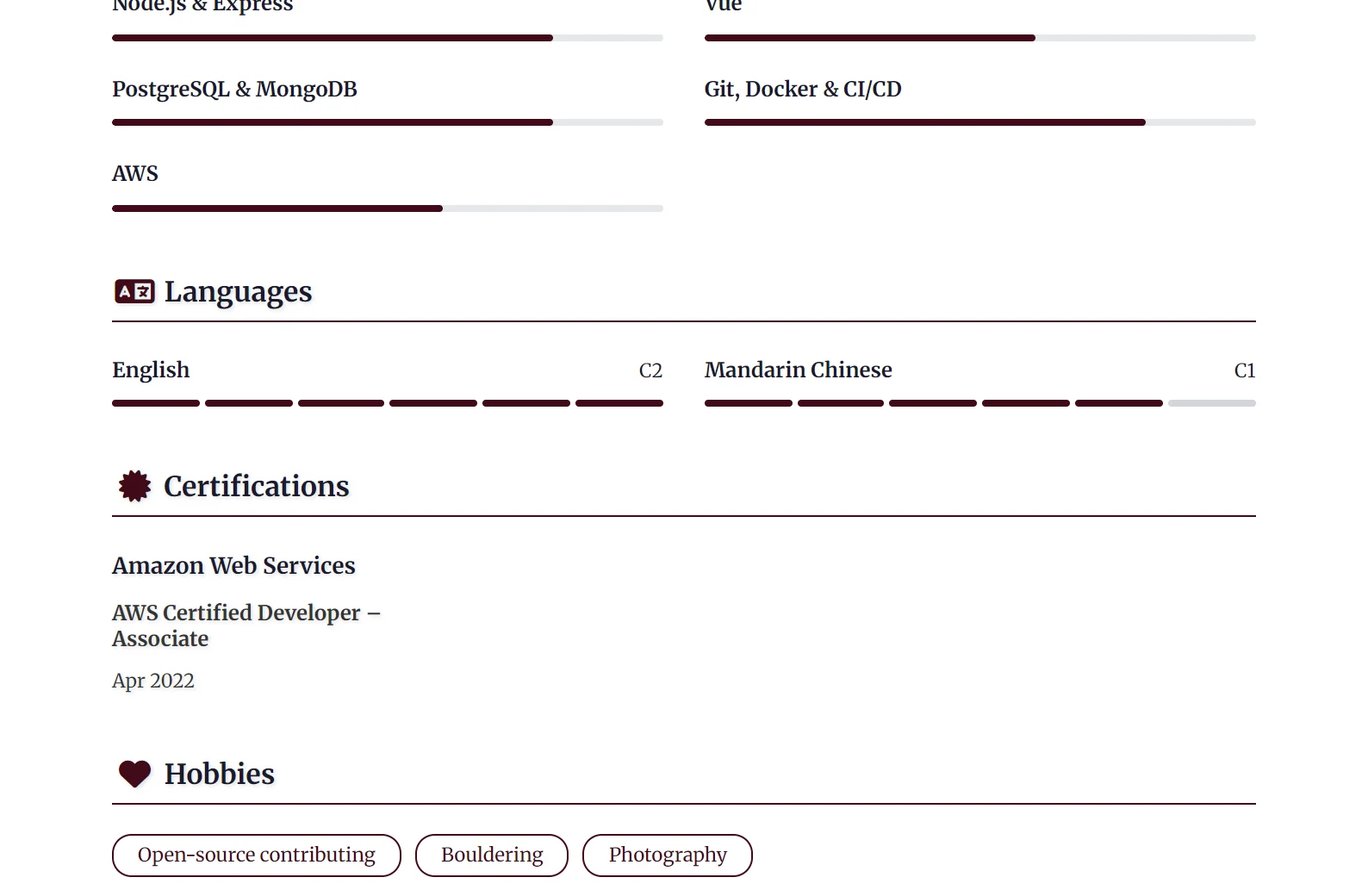
Include a hobby only if a stranger would still remember it after one read. That single test settles the whole include-or-cut question. The standard advice on hobbies is contradictory — some guides say include them, others say cut them — and both are right, depending on the hobby. "Reading, travelling, watching movies" actively hurts a CV because it says nothing distinct about you. "Distance running (2024 Berlin Marathon finisher), self-taught bookbinder, volunteer Hungarian tutor at a refugee centre" makes a recruiter pause and remember you. Used well, a single specific line can be the thing a recruiter remembers about you a week later; used lazily, it's wasted space that quietly signals you didn't think about the section. This short guide covers when hobbies help, what they actually do for a CV, which generic entries to cut, the categories that genuinely signal something, how to phrase and format the section, which interests to handle with care, how to tailor lightly to the role, how early-career candidates can use hobbies, the regional differences, and when to drop the section entirely.
Generic out, specific in
| Forgettable | Memorable |
|---|---|
| Reading | Reading 19th-century Russian literature; currently working through Tolstoy's letters |
| Travelling | Travelled solo across Central Asia in 2023 — Kazakhstan, Uzbekistan, Kyrgyzstan |
| Cooking | Cooking regional Sichuan food; built a small fermentation setup at home |
| Sports | Marathon runner, three finishes since 2024; training six mornings a week |
| Music | Play in a four-piece jazz band; two gigs a month in the city |
| Volunteering | Captain of the university climbing club; organised three inter-university competitions |
Title the section 'Interests' or 'Outside work', keep it to one line, and list three to five items. If your best version of a hobby is still generic, drop the section — empty space beats uninformative space.
Should you put hobbies on a CV at all?
The honest answer is: only if they're specific. Hobbies are the lowest-priority section on a CV, so they have to earn their space — and most don't, because most people list generic ones. The decision rule:
- Include a hobby only if it's specific enough that a stranger would remember it after one read
- If your best version of a hobby is still generic ('reading', 'sports'), leave the section off — empty space beats uninformative space
- Hobbies never win the job on their own; they're a tiebreaker and a humaniser, so treat them as a bonus, not a core section
- When the CV is tight on space and the experience is strong, hobbies are the first thing to cut
So the real question isn't 'hobbies: yes or no?' — it's 'do I have a hobby specific enough to be worth the line?' If yes, use it well; if no, skip the section entirely and lose nothing.
The builder lets you drop the section entirely when it earns nothingWhat hobbies actually do: they break ties
It helps to be clear about the job hobbies do, because it's smaller and more specific than people assume:
- They don't get you hired — your experience and skills do that. They break ties between similar candidates
- When a recruiter is choosing between two equally-qualified people, the one with a memorable, slightly unusual interest is the one they remember and forward
- 'That marathon runner' is sticky; 'the candidate who reads and travels' is instantly forgotten
- They also give the interviewer an easy, human opener — a specific hobby seeds a warmer conversation
Frame hobbies as the detail that makes you memorable at the margin, not as evidence of competence. That's exactly why specificity matters so much — a forgettable hobby does the one job hobbies have (being memorable) badly.
What recruiters actually scan for, and where hobbies fit in their decisionCut the generic, keep the specific
Most hobby sections fail because they're built from the same handful of dead entries. Cut these on sight: reading, travelling, watching movies, listening to music, spending time with family, going to the gym, cooking. Every other CV says them, and they convey nothing. The fix is almost always to get specific:
- 'Reading' → 'reading 19th-century Russian literature; currently working through Tolstoy's letters'
- 'Travelling' → 'travelled solo across Central Asia in 2023 — Kazakhstan, Uzbekistan, Kyrgyzstan'
- 'Cooking' → 'cooking regional Sichuan food; built a small fermentation setup at home'
- 'Sports' → 'competitive bouldering (climbing V6); training for an outdoor lead season'
- 'Music' → 'collecting and mixing vinyl; resident DJ at a small monthly night'
- 'Gym' → 'powerlifting; training toward a 180 kg deadlift'
The same underlying interest goes from filler to memorable purely through specificity. If you can't make a hobby concrete and distinctive, it isn't earning its line — and a vague version is worse than nothing.
The hobby categories that signal something
Some categories of interest reliably read well, because they hint at a trait an employer values. Lean toward these when you have a genuine, specific example:
- Physically rigorous (running, climbing, cycling) — signals discipline and persistence
- Creative with output (writing, music, illustration, craft) — signals sustained making, not just consuming
- Competitive at a real level (chess, debate, e-sports) — signals drive and the ability to improve
- Cross-cultural (languages learned for fun, regional cooking, international interests) — signals curiosity and adaptability
- Technical outside your job (homelab, electronics, open-source) — signals genuine, self-directed interest in the craft
- Community-oriented (volunteering, organising meetups, club leadership) — signals initiative and people skills
The signal is a bonus, not the point — never invent an interest to hit a trait. But when a real hobby happens to demonstrate discipline, creativity or initiative, phrase it so that connection is visible to the reader.
How to format the interests section
Formatting is simple and the rules are firm — this is a one-line flourish, not a section to expand:
- Title it 'Interests' or 'Outside work' rather than 'Hobbies' — it reads slightly less juvenile
- Keep it to one line (two at most on a longer CV); list 3–5 items separated by commas or pipes
- Don't expand into paragraphs or bullet points — brevity is part of the signal
- Put it at the very bottom; it's the closer, not a headline section
- Example: 'Interests: distance running (Berlin Marathon 2024), self-taught bookbinder, volunteer ESL tutor.'
A tight, specific one-liner at the foot of the CV does the whole job: three or four concrete, conversation-starting interests, then stop. This is the same discipline that governs the rest of the document — say the specific thing, and don't pad.
How the same 'specific over generic' discipline shapes a strong skills sectionHobbies to handle with care
A few interests carry risk, or simply invite the wrong kind of attention. Include them only with judgement, and only if you can defend them comfortably in an interview:
- Anything signalling a political or controversial stance (party activism, divisive causes) — it invites bias you can't control
- Religious activity, unless directly relevant to the role — for the same reason
- Extreme-risk sports — some recruiters genuinely worry about availability or risk; weigh it by field
- Commitments that hint at overload — interests so demanding they raise questions about your time
- 'Interview-bait' that you can't back up — 'writing a novel' you've never finished invites a question you'll fumble
- Anything that could read as a red flag in context — be honest, but be aware of how an unfamiliar reader might interpret it
The test is whether you'd be glad to be asked about it in the interview. If a hobby could prompt a biased reaction or a question you can't answer well, leave it off — being memorable is only an asset when it's memorable for the right reason.
Tailoring hobbies to the role
You don't fake interests, but you can order and emphasise the real ones to fit where you're applying. A light touch signals you understand the culture:
- Creative agency: lead with your music, illustration or writing — distinctive personal craft is a genuine asset there
- Quantitative or finance role: lead with your chess rating, competitive maths or strategy games
- Startup: emphasise side projects, building things, and self-directed learning
- Conservative corporate or public sector: keep it safe, well-rounded and uncontroversial
Reorder, don't fabricate. Putting the most role-relevant real interest first is a small, honest signal that you've thought about the specific culture you're applying into — which is exactly the kind of attentiveness creative and culture-led teams notice.
Why distinctive personal interests carry extra weight in creative rolesHobbies when you have little experience
For students and recent graduates, interests do more work than they ever will later — they're a place to show initiative, drive and personality when the experience section is thin:
- A specific, sustained interest (a sport pursued to a real level, a craft, a side project) signals the self-direction employers want in juniors
- Leadership and community roles (society committee, volunteering, organising) double as soft-skill evidence
- Still be specific — 'captain of the university climbing club, organised three inter-university competitions' beats 'climbing'
- Don't pad: two or three real, distinctive interests beat a long list of generic ones, even on a sparse CV
Early in a career, a well-chosen interests line is a low-cost way to add personality and signal initiative — but the specificity rule is even more important here, because it's one of the few places a student can stand out.
How to build a strong CV when you have little or no formal experienceRegional differences, and when to drop the section
Conventions vary, and so does whether the section is worth keeping at all. Two practical calls to make:
- Regional norm: an interests line is common and expected in much of continental Europe; in the US and UK it's optional and more often dropped on experienced CVs — match the local convention
- Seniority: the more experienced you are, the less the section earns its space — senior CVs usually drop it in favour of more achievement detail
- Space: if the CV is at its page limit and the experience is winning, cut hobbies first — they're the lowest-priority section
- The final test for every line, hobbies included: 'why does the recruiter care about this?' If a hobby can't answer that, drop it
Use the interests section when you have something specific to say and the space to say it; drop it without hesitation when you don't. A tight CV with no hobbies always beats a sprawling one padded with generic ones — empty space is better than uninformative space.
Frequently asked questions
Should you put hobbies on a CV?
Only if they earn their space. A hobby is worth listing when it evidences something the job needs — sustained commitment, leadership, technical skill, or language exposure. If it is there to fill a gap or make you look well-rounded, cut it and use the room for achievements.
Which hobbies look good on a CV?
Ones with visible commitment or a result attached: team sports you have captained, endurance events you have finished, a side project with users, competitive chess, volunteering with a defined role. Specific beats generic — "distance running, two marathons completed" says more than "sport, travel, reading".
What hobbies should you leave off a CV?
Anything passive and unverifiable — "reading", "music", "travelling", "socialising with friends". Also anything politically or religiously charged, and anything that hints at a risk the employer would rather not think about. When a hobby needs a caveat, it does not belong on the page.
Where should hobbies go on a CV?
Last, after education and skills, in two or three lines at most. The exception is early-career CVs, where a substantial extracurricular commitment may be genuine evidence of responsibility and can sit higher, closer to projects.