
Should You Include a Photo on Your CV? (Country-by-Country Guide)
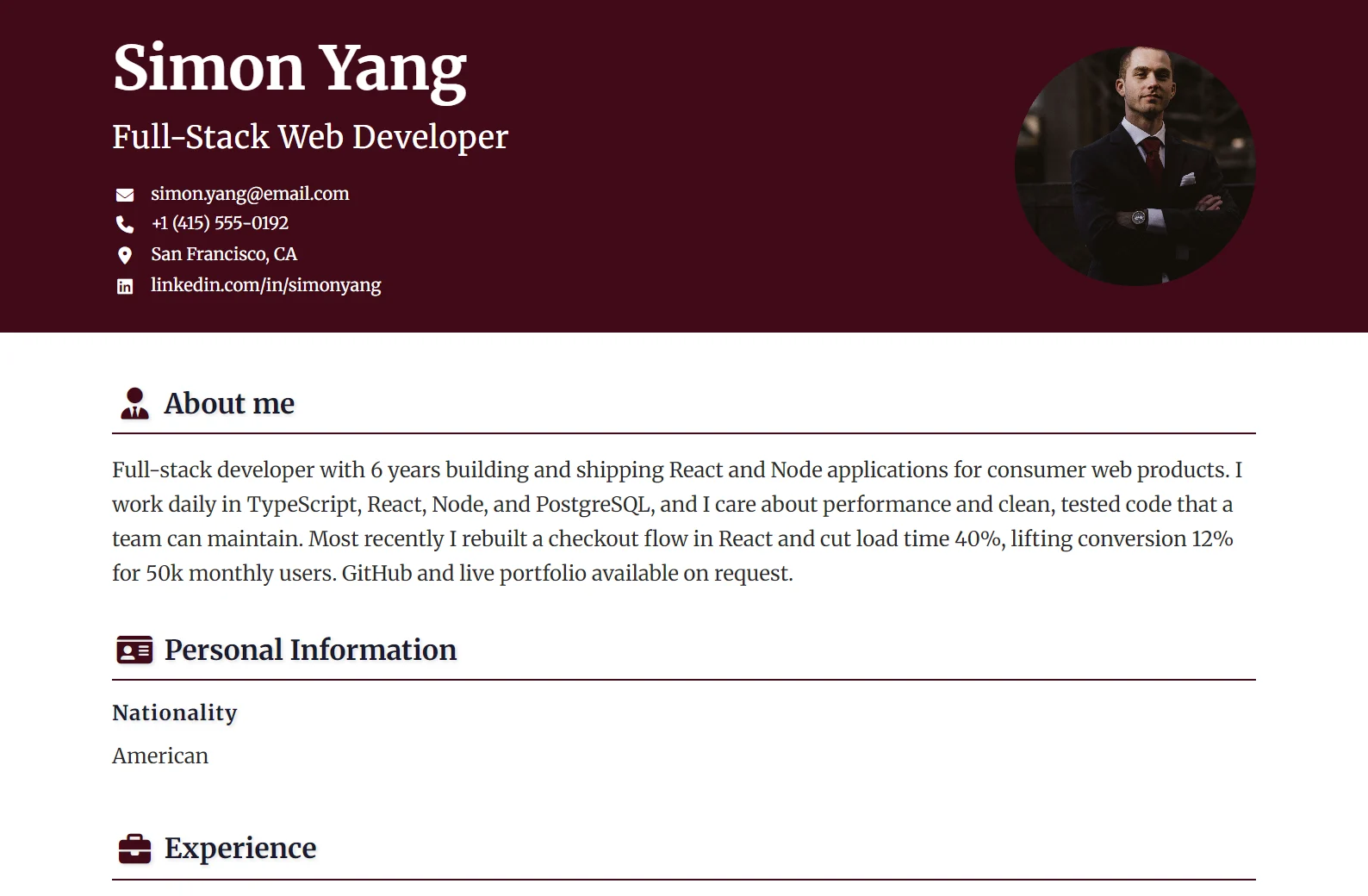
In the UK, the US, Canada and Australia, leave the photo off — a recruiter may discard a CV that has one, to keep the shortlist defensible. In Germany, Austria, Switzerland, most of Asia and Latin America, put it in: a CV without one reads as unfinished. The country you are applying to decides this, not your taste, and getting it wrong costs you the application before anyone reads a word.
CV photo by country
| CV photo convention | Countries | What happens if you get it wrong |
|---|---|---|
| Photo expected |
| A CV without one reads as unfinished. |
| Optional — either is fine |
| Neither choice counts against you. |
| Leave it off |
| Some screeners discard a CV with a photo on sight. |
What decides this is the market you are applying to, not your nationality. Applying from Germany to a UK employer means the UK rule applies.
The geographic map of CV photos
Three broad categories cover almost every country you'll apply to. Identify which one applies before any other photo decision.
| Region | Photo expected? | What happens if you get it wrong |
|---|---|---|
| Germany, Austria, Switzerland | Yes, almost always | A CV without one reads as unfinished |
| Central and Eastern Europe | Yes, commonly | Rarely fatal, but you look out of step |
| Southern Europe (ES, IT, PT, FR) | Common, not required | Neither choice counts against you |
| Middle East and most of Asia | Yes, expected | Japan’s rirekisho makes it non-negotiable |
| Latin America | Yes, commonly | Omitting one is unusual but accepted |
| United Kingdom and Ireland | No | Some recruiters discard it on sight |
| United States and Canada | No | Screeners may reject it to avoid bias claims |
| Australia and New Zealand | No | Only for acting and modelling roles |
Countries where a photo is expected
In these markets recruiters expect a photo and a CV without one looks incomplete. The standard is a professional headshot, business attire, neutral background — what specifically counts as "professional" varies slightly by region.
- Germany, Austria, Switzerland — the German-speaking DACH region has the strongest photo culture. Almost all CVs include one
- Eastern and Central Europe — Poland, Czech Republic, Slovakia, Hungary, Romania widely include photos. CVs without one read as unfinished
- Southern Europe — Spain, Italy, Portugal, France use photos commonly though not strictly required; roughly 60-70% of CVs include one
- Most of Asia — Japan, South Korea, China, India treat photos as standard. In Japan the specification can be especially formal (specific dimensions, formal pose)
Countries where a photo is neutral
Including a photo is fine; omitting it is also fine. The decision doesn't significantly affect outcomes either way, and recruiters don't read it as a signal in either direction.
- Netherlands, Belgium — both options are common and accepted
- Scandinavian countries (Sweden, Norway, Denmark, Finland) — leaning slightly toward no-photo but neither is wrong
- Parts of Eastern Europe that haven't fully converged with the German tradition
Countries where a photo is actively discouraged
In these markets including a photo can hurt your application. Many companies will not consider a CV with a photo because doing so creates legal liability around demographic-based hiring; some ATS systems automatically strip photos and the strip can corrupt your CV's parsing. The downside risk is real; the upside is essentially zero.
- United States, Canada — anti-discrimination law and a strong blind-hiring movement push recruitment toward photo-less CVs
- United Kingdom, Ireland — same legal logic, same convention
- Australia, New Zealand — similar anti-discrimination framework
Why these patterns exist — the legal and cultural roots
The geographic split isn't an aesthetic preference; it tracks two real forces:
- Anglophone markets have stricter anti-discrimination case law and stronger "blind hiring" practices. Companies have been sued or fined for hiring decisions correlated with photo-visible characteristics; the safe move is to never see the photo at all
- Continental Europe and most of Asia have historically treated the CV as a personal document. The same documents often include date of birth, marital status, and other personal markers that would be unusual on a US CV
- Neither system is right or wrong — they're different defaults that grew out of different legal histories
What this means practically: don't argue with the local convention based on what you think "should" be the rule. Match local norms in every market you apply to. A US applicant putting a photo on their CV because that's "more European" misreads both systems.
The same split explains CV vs resume conventionsIndustry overrides within countries
Country-level convention is the default. Industry-level convention overrides it. Three patterns matter:
- Creative industries (design, fashion, advertising, media) often expect photos even in countries that generally don't. A designer's CV without a photo can read as unfinished in markets that otherwise discourage photos
- Conservative industries (law, banking, accounting, government) often discourage photos even in countries that generally include them. The legal-liability concern leaks from Anglophone markets into Continental European corporate law and finance
- Senior leadership positions trend toward fewer photos across all markets. At the executive level your reputation precedes the document, and including a photo can read as overstating something the reader already knows
If your country says yes but your industry says no, follow your industry. The hiring manager in that specific field sees those conventions every day; an off-pattern CV in their inbox will read as not-quite-right even if they can't articulate why.
More CV decisions where industry overrides general adviceHow to take a CV photo that helps, not hurts
If you've decided to include a photo, the difference between a good one and a bad one is measurable. Recruiters in photo-expected markets see hundreds of CV photos a year and can spot an amateur photo in under a second. Five rules cover almost every case:
1. Lighting
Soft natural light is the single biggest factor. Stand facing a large window (north-facing if you can — it gives even, indirect light). Avoid overhead office lighting, which casts hard shadows under your eyes. Avoid direct sunlight on your face, which creates harsh contrast and squinting. If you're shooting indoors at night, two desk lamps with white-paper diffusers on either side of you beat a single ceiling bulb.
2. Wardrobe
One notch above the daily dress code of the role you're applying to. If the job is business-casual, wear a smart shirt or blouse. If the job is formal corporate, wear a suit jacket. Solid colours work better than busy patterns in photos. Avoid pure white (washes out against most backgrounds) and pure black (loses shape against dark backgrounds). Mid-tones — navy, grey, soft blue, burgundy — photograph well across most settings.
3. Framing and composition
Crop from mid-chest up. Your eyes should sit about one-third from the top of the frame (the rule-of-thirds applies to portraits too). Hold the camera at eye level — never below, which produces an unflattering up-the-nose angle, and rarely above, which makes you look small. Smartphone photos work fine if you can prop the phone at eye level using books or a tripod.
4. Background
Plain, neutral, uncluttered. A blank wall, a neutral curtain, or a softly out-of-focus outdoor background all work. Avoid busy backgrounds (bookshelves, kitchens, anything with text or strong patterns). The background should fade behind you, not compete for attention.
5. Expression
Friendly but composed. A small natural smile (not a forced one), eyes engaged with the camera, head and shoulders relaxed. Practice in front of a mirror — most people look more relaxed after the fifth or sixth attempt. The goal is "approachable competent professional", not "corporate headshot template" and not "vacation selfie".
Common photo mistakes to avoid
- Selfies with the camera below face level (unflattering angle)
- Cropped group photos — visible cut-off shoulders signal you didn't take a proper photo
- Vacation photos, sports photos, casual settings
- Sunglasses or photos taken outdoors in bright sun (squinting + obscured eyes)
- Heavy filters, dramatic colour edits, beauty-app retouching
- Photos clearly more than 3 years old or where you no longer resemble the image
Many candidates get a professional headshot for €50-€150. It's worth it if you'll use the same image across CV, LinkedIn, and conference bios for the next few years. The cost amortises across every application; the polish reads in every market that expects a photo.
The photo is one piece of how you present yourself across every channelWhen you don't include a photo
If you've decided against (Anglo markets, or when in doubt), there's no need to explain or apologise. Your CV simply opens with name, contact details, headline role, and summary. No photo, no awkward space, no compensation needed.
Two practical points on photo-less CVs:
- The space the photo would have occupied is just additional room for content — use it for a tighter summary or one extra line of recent role detail, not for white space
- The layout shifts slightly: instead of a horizontal header with photo + contact details split left/right, the contact details can run as a single centred or left-aligned block under your name. Both look clean
Recruiters in photo-less markets don't even register the absence of a photo. The information density compensates for the missing visual; there's nothing to fix.
How layout decisions cascade once you've made the photo callPhoto placement on the page
If you've decided to include one, three placement decisions remain:
- Position — top-right is the most common in DACH and Eastern Europe; top-left is more common in Southern Europe; centred above the name is rarer but increasingly used in design-forward templates. Match what local templates do
- Size — roughly 3-4 cm wide by 4-5 cm tall (about passport-photo proportions). Smaller looks like an afterthought; larger competes with the rest of the page
- Shape — a clean rectangle is standard. Circular crops have become more common in modern templates but can read as informal in conservative sectors. When in doubt, rectangle
Most modern CV templates handle photo placement automatically; if you're using a builder, just upload and the template positions it correctly. If you're laying out manually, copy what you see in 3-4 sample CVs from your country and industry.
Every square centimetre the photo takes is space an achievement could have usedThe reuse principle — one photo, multiple platforms
Once you have a good headshot, use the same one everywhere: CV, LinkedIn, company About pages, conference bios, Slack profiles. Two reasons:
- Consistency makes you instantly recognisable across the platforms where a recruiter or interviewer might check you. A CV photo that matches the LinkedIn photo lands as the same person at first glance
- It saves you the cost and effort of taking a new photo for every channel. Investing once in a strong shot pays off across every professional surface for the next 2-3 years
Refresh the photo every 2-3 years, or sooner if your appearance has materially changed (significant weight change, new glasses, different hair length or colour, beard added or removed). The goal is that someone meeting you in person recognises you from the photo without effort.
The same headshot has to work on your LinkedIn profile tooPre-send photo checklist
- Photo convention matches the country you're applying to (yes/neutral/no)
- Industry convention checked — creative may override no-photo markets; conservative may override yes-photo markets
- Soft natural light, no harsh shadows, no overhead office light
- Wardrobe one notch above the daily dress code of the role
- Cropped from mid-chest up, eyes one-third from the top, camera at eye level
- Plain neutral background, no clutter
- Friendly composed expression — small natural smile, engaged eyes
- Same photo across CV, LinkedIn, and other professional profiles
- Photo less than 3 years old and still looks like you today
- If no photo: contact details laid out cleanly under your name, no awkward space
The photo decision sounds small but compounds across every application. Get it right once per market, get the photo itself right once every 2-3 years, and you stop thinking about it. The recruiters who matter see a competent professional regardless of which convention your CV follows.
How the photo fits with the rest of your per-application tailoringFrequently asked questions
Should you put a photo on your CV?
It depends entirely on where you are applying. In Germany, Austria, Switzerland and much of southern and eastern Europe a photo is normal and its absence is noticed. In the UK, Ireland, the US, Canada and Australia you should leave it off — many employers discard CVs with photos to protect themselves against discrimination claims.
Which countries expect a CV photo and which reject it?
Expected or accepted: Germany, Austria, Switzerland, France, Spain, Portugal, Italy, Poland, Romania and most of the Balkans. Avoid entirely: the UK, Ireland, the US, Canada, Australia, New Zealand, the Netherlands and Sweden. When in doubt, follow the convention of the country the job is in, not the one you live in.
Does a photo stop your CV getting through an ATS?
The photo itself rarely breaks parsing, but the layout built around it often does. Photos usually sit in a header, a sidebar or a text box, and those are exactly the structures applicant tracking systems read badly. If you include one, keep the rest of the page single-column and text-based.
What makes a good CV photo?
Head and shoulders, eyes level with the camera, plain uncluttered background, soft even light from the front, and clothing one small step smarter than the role's daily dress code. Neutral expression or a light smile. Not a cropped holiday snap, not a selfie, not a photo more than about two years old.